
Green roofs have moved from niche product to near-standard on a lot of UK development. Local plans ask for them, drainage strategies rely on them, and clients increasingly expect them. But the term covers a huge range of build-ups, from a 40mm sedum blanket on a bin store to a landscaped terrace with mature trees, and the difference matters enormously for cost, loading and maintenance.
This guide covers what a green roof actually is, the main types of green roof used in Britain, what they do well, and the disadvantages of green roofs that rarely make it into the brochure.
From a development perspective, most conversations about green roofs concentrate on the layers you never see, such as waterproofing, drainage, root barriers, loading calculations.
But the layer everyone can see is the one that decides whether the roof does what the planning statement said it would. A roof planted with a single genus of succulent and a roof planted with 38 UK native species behave completely differently once they are up there. We have spent over twenty years researching and growing the vegetation that goes on top.
Here is how green roof systems work, what the realistic options are, and what to specify if biodiversity is genuinely one of your objectives.
Green roofs have moved from niche product to near-standard on a lot of UK development. Local plans ask for them, drainage strategies rely on them, and clients increasingly expect them. But the term covers a huge range of build-ups, from a 40mm sedum blanket on a bin store to a landscaped terrace with mature trees, and the difference matters enormously for cost, loading and maintenance.
This guide covers what a green roof actually is, the main types of green roof used in Britain, what they do well, and the disadvantages of green roofs that rarely make it into the brochure.
From a development perspective, most conversations about green roofs concentrate on the layers you never see, such as waterproofing, drainage, root barriers, loading calculations.
But the layer everyone can see is the one that decides whether the roof does what the planning statement said it would. A roof planted with a single genus of succulent and a roof planted with 38 UK native species behave completely differently once they are up there. We have spent over twenty years researching and growing the vegetation that goes on top.
Here is how green roof systems work, what the realistic options are, and what to specify if biodiversity is genuinely one of your objectives.
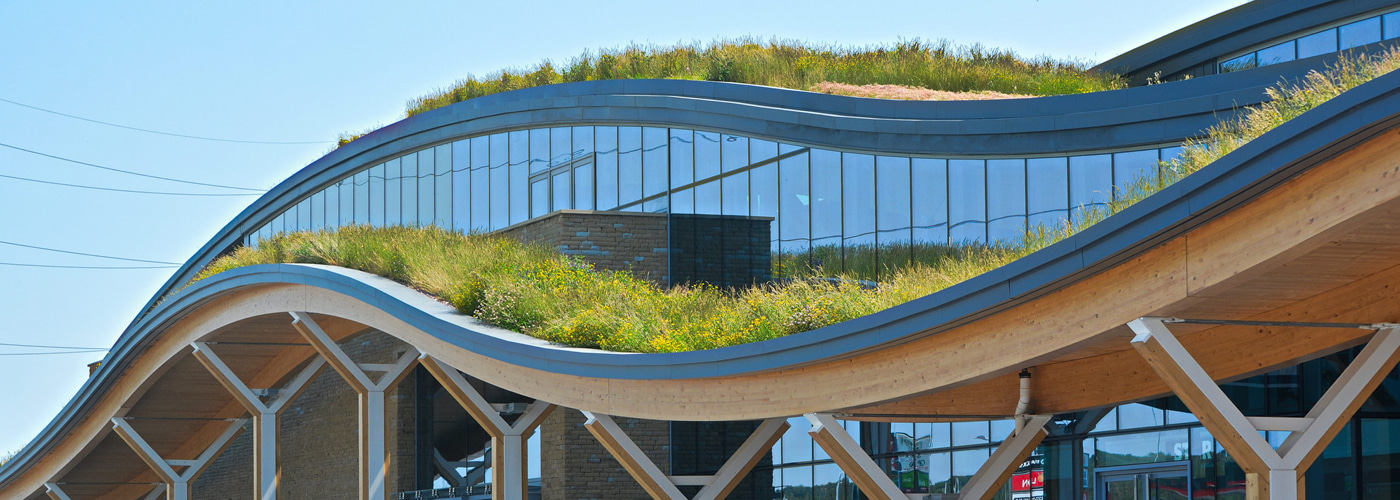
A green roof is a roof covered with living vegetation growing above the waterproofing of a building. The plants are supported by a growing medium, which sits on a drainage layer, which in turn sits on a root-resistant membrane protecting the roof structure below.
You will hear the term living roof used interchangeably, and some specifiers use it to signal something more ecologically ambitious than a standard finish (there is no formal distinction). What actually separates one green roof from another is depth, plant species and the quality of the detailing.
Almost any flat roof or shallow-pitched roof can carry vegetation if the structure allows for the loading. Our own green roof turf has been installed on everything from 10m² garden buildings to the 5,000m² curved roofs at Alder Hey Children’s Hospital.
A green roof system is a layered assembly, and every layer has to be specified as part of the same design rather than picked off separate shelves. Working upwards from the deck:
Vegetation-free margins of gravel or paving are also required at perimeters, around outlets and around rooflights, for maintenance access and as a fire break.
UK practice recognises three green roof types, classified by depth and intended use rather than by planting style.
An extensive green roof uses a shallow growing medium, commonly 60mm to 150mm, planted with species that survive without permanent irrigation.
It is not designed to be walked on except for maintenance. Extensive roofs are the lightest option and the most widely specified in Britain, and this is the category our green roof turf is developed for.
An intensive green roof carries 200mm or more of growing medium and can support shrubs, lawn and, in deeper build-ups, small trees.
These can be considered roof gardens – usable amenity space with paving, seating and irrigation. Intensive roofs weigh several hundred kilograms per square metre saturated and need designing in from the outset.
A biodiverse green roof is designed to recreate habitat rather than to look uniform. Varied depths, gravel and sand mounds, deadwood and appropriate native seed mixes create conditions insects and invertebrates can actually use. This is where a native wildflower finish belongs, and where the ecological case for the roof is won or lost.
Plenty of schemes combine extensive and intensive green roofs across different parts of one building.
Sedum has dominated the market for two decades, and it is easy to understand why. Sedum stores water in its leaves, tolerates thin growing media, copes with wind exposure and greens up a roof quickly.
The problem is what it delivers afterwards. A sedum blanket is close to a monoculture. It flowers over a short window, supports a narrow range of pollinators, and offers very little structural variety for anything living in it. If the specification says biodiversity and the finish is sedum alone, the brief hasn’t been met.
A native wildflower finish solves that problem. Our Green Roof Wildflower Turf contains 38 UK native wildflower and grass species, including thrift, viper’s bugloss, kidney vetch, ragged robin and cornflower, with fescues and quaking grass underneath.
Kidney vetch alone is the sole larval food plant of the small blue butterfly. Viper’s bugloss is one of the most productive nectar sources in the British flora. That is a different proposition from a mat of succulents.
The species were selected through trials and R&D for drought tolerance, wind resistance and reliable establishment in exposed rooftop conditions, to ensure longevity.
The benefits of green roofs split in three distinct ways: what they do for the building, what they do for the environment, and what they do for the people living in the spaces.
For the building, the most measurable gain is protection. A conventional roof membrane is exposed to ultraviolet light and daily thermal cycling, both of which degrade it over time. Covering it removes most of that stress. The lifespan of a roof membrane beneath a green roof is substantially longer than an exposed one.
There is a thermal effect too. The growing medium and vegetation add mass and insulation, reducing summer heat gain noticeably and contributing to the energy efficiency of the building overall.
The addition of a green roof also reduces airborne sound transmission, which is well worth having under a flight path or beside a busy road.
The environmental benefits of green roofs are why planning authorities keep asking for them.
A well-planted roof provides habitat where habitat has been removed. Invertebrates arrive quickly, and birds follow the invertebrates.
Species richness in the planting is the variable that matters most here, which is precisely why the finish is not a cosmetic decision.
A green roof holds rainfall in the growing medium and the drainage layer, returns some of it to the atmosphere through evapotranspiration, and slows the rest.
For stormwater management purposes, peak-flow attenuation usually matters more than total retention, and this is what earns a green roof its place in a drainage strategy.
Vegetated surfaces stay cooler than dark membranes. Black flat roofs reach extreme surface temperatures in summer, and replacing a proportion of them with green rooftops helps reduce the heat island effect at street level.
It takes coverage across a district to meaningfully mitigate the urban heat island in dense urban areas, which is an argument for more roofs rather than a reason to dismiss the effect.
A biosolar roof combines panels with planting. The vegetation keeps the roof surface cooler, which improves panel output, and the build-up provides ballast without penetrating the membrane.
A roof with solar and wildflower turf together works well, provided panel spacing and access routes are planned before anything is laid.
The social benefits are harder to measure and easy to underrate. Accessible roof terraces give people somewhere to go. Inaccessible ones still change what people see out of a window, and the evidence linking views of vegetation to wellbeing and recovery is now substantial.
Alder Hey Children’s Hospital is the clearest illustration we have. Curved, difficult roofs, 5,000m² of a bespoke drought-tolerant wildflower blend, and a result that children and families look out onto every day.
A flowering roof that changes through the season does something a flat green rectangle does not.
A blue roof stores rainfall deliberately in a void beneath the finish and discharges it slowly through a flow-control device. Where a green roof retains water incidentally, a blue roof does it to a calculated volume.
The two are frequently combined. A blue-green build-up gives predictable attenuation from the storage layer and the ecological and thermal gains from the planting above. On constrained urban sites with severe discharge restrictions this is often the only viable roof solution, and it reduces the load on below-ground water management infrastructure.
A green wall applies the same thinking vertically. Modular irrigated systems achieve dense coverage quickly.
Green roofs and walls are often specified together where a scheme needs a greening score across the whole envelope. However there are ongoing cost considerations as living walls are irrigated, fertilised, actively managed systems, and they fail when that management stops.
On new build, everything is easier. Loading is designed in, outlets are sized correctly, access is provided, and the roof design is coordinated with plant, rooflights and often solar from the beginning.
Policy is driving the demand. Biodiversity net gain has made on-site habitat creation valuable to developers, and the London Plan’s Urban Greening Factor sets target scores that green roofs contribute towards. Local plans outside London increasingly carry equivalent green infrastructure requirements.
Where a scheme has BNG obligations, the planting specification starts to become a compliance question. A species-rich native roof and a sedum roof are not equivalent under scrutiny.
Implementing a green roof after the structure has been designed is expensive and sometimes impossible, therefore it is beneficial to raise it at concept stage.
Low maintenance is not no maintenance, and this is where most disappointing roofs come from.
A wildflower roof takes two to three months to establish and reaches full flowering across its first twelve months. That first year needs attention through occasional watering in dry spells, checking that outlets and drainage are clear, and letting the plants get away.
After that, roof maintenance settles into an annual mow once the plants have flowered and set seed, plus periodic inspections, removal of any tree saplings that have self-seeded, and checking the vegetation-free margins.
Blocked outlets are the single most common cause of trouble on any roof. A blocked outlet turns a green roof into an unintended pond, and the loading implications of that are serious.
A workable sequence for any green roof project:
One roof does not transform a local environment. A network of them, connected to street trees, rain gardens, verges and parks, is genuine green infrastructure and behaves as a system.
The UK green roof industry is still small next to Germany, where decades of municipal incentive have made roof greening routine, and uptake of green roofs in the United States has grown fastest in cities that operate stormwater credit schemes.
Green roofs offer more per square metre than almost anything else on a building, from habitat for insects, drainage performance, thermal moderation, and even just something worth looking at.
If you are working on a scheme where the roof needs to do real ecological work, talk to us before the specification is fixed. We can advise on species, supply the turf, and put you in touch with an accredited installer who has laid it before.
Enter your details to access this file