Location: Ashe Warren Farm, Overton, Hampshire
Project type: Habitat creation and long-term biodiversity research
Area: Approximately 400 m²
Established: 2003
Solution: Locally grown native wildflower turf
When it comes to Biodiversity Net Gain (BNG), creating a habitat is only the beginning. The real challenge is establishing a thriving ecosystem that can develop and sustain its ecological value over time.
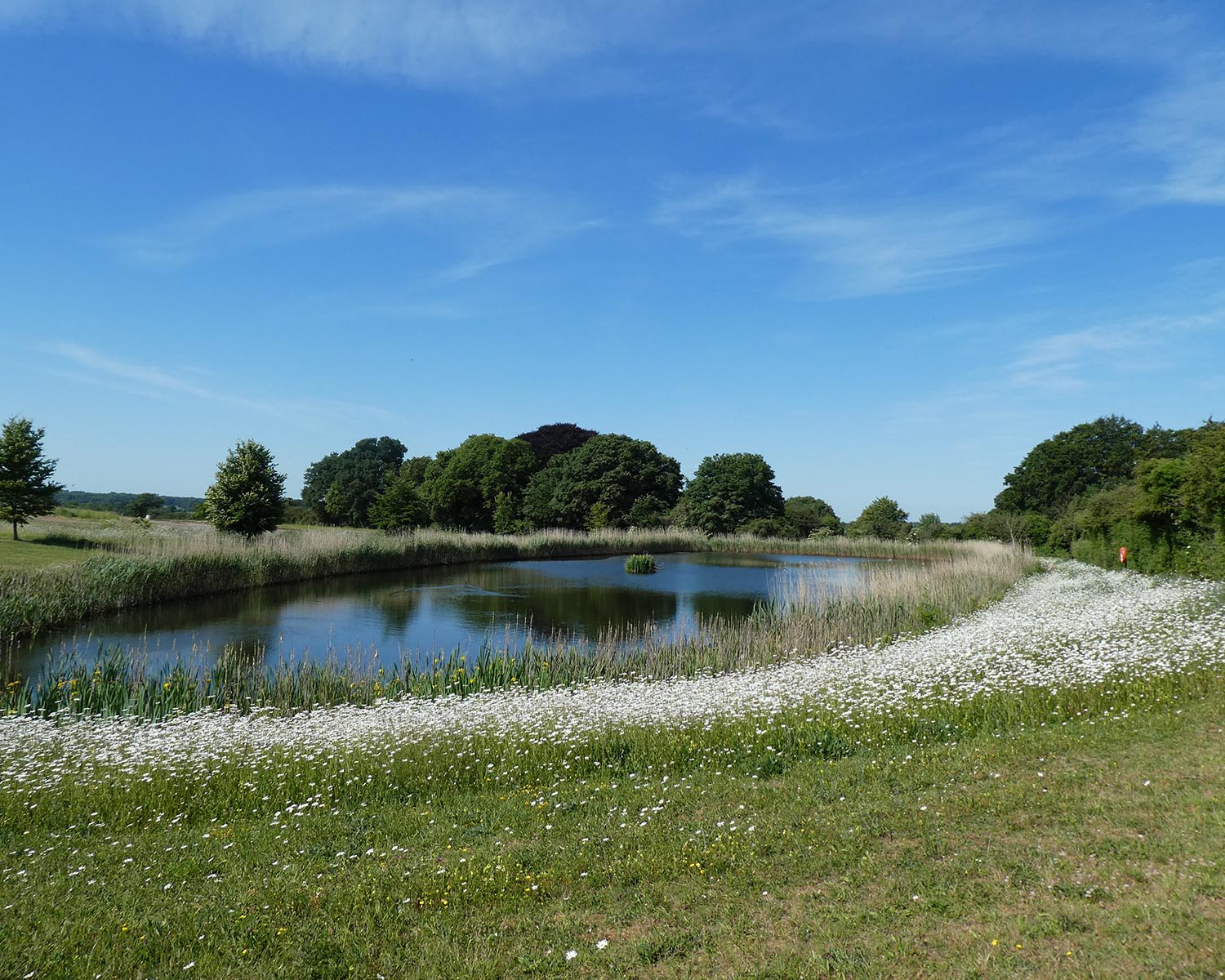
At Ashe Warren Farm in Hampshire, a wildflower meadow established more than 20 years ago offers valuable insight into what long-term habitat creation can achieve.
In 2003, Wildflower Co. laid native wildflower turf around the margins of a man-made lake on land previously used for intensive arable farming.
Today, the meadow has developed into species-rich lowland calcareous grassland, recognised as a Section 41 Priority Habitat. It supports an impressive diversity of native plants, specialist grassland fungi and naturally occurring orchids that were never part of the original planting.
This long-term transformation provides compelling evidence of the potential for wildflower turf to support the creation of biodiverse, resilient habitats — an increasingly important consideration for BNG projects.
The project began with approximately 400 m² of former arable land, where locally grown native wildflower turf was installed in 2003.
Unlike establishing a meadow from seed, laying wildflower turf provides an immediate community of established native plants, complete with their roots and associated soil biology.
This can provide important advantages during establishment, helping native species compete with weeds while giving the developing habitat a strong foundation.
For BNG projects, this established starting point may offer an additional benefit. Mature wildflower turf can potentially reduce the time needed to achieve a target habitat condition compared with seed-based establishment. Where appropriately evidenced and agreed with the project’s ecologist, this may be reflected in the statutory biodiversity metric, potentially increasing the biodiversity units calculated.
Since installation, the Ashe Warren Farm meadow has been managed through a simple, consistent regime: one cut each autumn, with the cuttings collected and removed.
No fertilisers, pesticides or irrigation have been applied in more than two decades, and only occasional hand-weeding has been necessary.
This approach has allowed the meadow to develop naturally, while providing Wildflower Co. with a valuable opportunity to observe how a created habitat matures over time.
From farmland to a recognised Priority Habitat
Perhaps the most significant outcome is the meadow’s development into lowland calcareous grassland, a nationally recognised Section 41 Priority Habitat.
Ecological assessments using several UK habitat classification systems have consistently identified the site as calcareous grassland.
Under UKHab, it is classified as g3c Other calcareous grassland, with fungal interest. National Vegetation Classification assessments also identify a mosaic of established chalk grassland communities.
This is particularly significant for BNG, where creating and maintaining habitats of appropriate type and condition is central to delivering meaningful ecological outcomes.
A species-rich wildflower community
Botanical surveys have recorded approximately 16 plant species per square metre, with a healthy balance of native wildflowers and grasses.
Species include cowslip, bird’s-foot trefoil, lady’s bedstraw, greater and lesser knapweed, betony, yellow rattle, quaking grass and wild marjoram.
This diversity demonstrates how an initially established wildflower community can develop into a rich and varied grassland habitat.
Orchids arrive naturally
One of the most remarkable developments has been the arrival of orchids that were never planted.
Bee orchids and pyramidal orchids first appeared in 2022, with flowering plants becoming so abundant by 2023 and 2024 that accurately counting individual plants was no longer practical.
In 2023, a rare hybrid orchid, Dactylorhiza × grandis, was also recorded. Its numbers have continued to increase, despite neither parent species having been recorded on site.
Orchids produce microscopic, dust-like seeds that can travel considerable distances on the wind. Seeds can also occasionally be transported in mud carried by animals, footwear or machinery.
Once dispersed, orchid seeds need very specific conditions to germinate and develop, including relationships with suitable soil fungi. Seeds may remain dormant while waiting for favourable conditions.
Although the exact route by which the orchids reached Ashe Warren Farm is unknown, their natural arrival suggests that the meadow has developed conditions capable of supporting species beyond those originally planted.
For BNG, this is particularly encouraging. It demonstrates how a successfully established habitat can continue to evolve, with opportunities for additional biodiversity to develop over time.
A thriving fungal community
The meadow’s ecological value isn’t limited to what can be seen above ground.
In autumn 2025, surveys recorded approximately 30 fungal species, including nine CHEGD grassland fungal indicator species.
These included snowy, blackening, parrot, orange and slimy waxcaps, alongside meadow coral, smoky spindles and silky pinkgill.
The site also achieved a score of 10 through Plantlife’s Waxcap Watch survey, identifying it as a waxcap grassland of interest.
Waxcaps are commonly associated with long-established, undisturbed, low-nutrient grasslands. Their presence on former arable land is particularly noteworthy, pointing towards the development of a more complex grassland ecosystem.
Soil conditions supporting lasting biodiversity
Soil testing provides further evidence of the meadow’s transformation.
In 2025, nitrogen, nitrate and phosphorus were below detection limits at almost every sampling point, despite the site’s agricultural history.
The soil’s alkaline pH, ranging from 7.5 to 9, is well suited to chalk grassland species.
Microbial testing in 2023 also revealed biologically active soil, with a microbial biomass of 308 μg C/g and a fungal-to-bacterial ratio of 35:65, indicating an ecosystem that is continuing to develop.
Together, these findings demonstrate the importance of considering soil health alongside plant diversity when evaluating long-term habitat success.
20+ years of habitat development on former arable land
~16 plant species per m² on average
~30 fungal species recorded in 2025
9 CHEGD indicator species identified
3 naturally arriving orchid types, including a rare hybrid
Zero fertiliser, pesticides or irrigation for more than two decades
One annual cut to maintain the meadow
As BNG becomes an established part of development and landscape planning, the focus must extend beyond initial habitat installation to long-term establishment, management and ecological performance.
The Ashe Warren Farm meadow provides encouraging real-world evidence of what native wildflower turf can achieve over more than two decades.
It highlights three important considerations for BNG projects: the value of establishing a strong native plant community from the outset, the importance of appropriate long-term management, and the potential for biodiversity to develop well beyond the original planting.
The choice of habitat creation method can also influence BNG calculations. Because established wildflower turf already contains a developed plant and root community, it may offer an advantage in reaching target habitat condition. Any adjustment to the statutory metric must, however, be supported by appropriate evidence and agreed with the project’s ecologist.
While the Ashe Warren Farm findings represent one relatively small site, rather than a guaranteed outcome across every project, they provide valuable insight into how species-rich grasslands can be created on previously intensively managed land.
At Wildflower Co., we use long-term observations like these to inform our research, refine our products and support customers seeking effective, science-led approaches to habitat creation.
Because successful Biodiversity Net Gain is about more than establishing a meadow today. It’s about creating the conditions for biodiversity to flourish for decades to come.
Discover how Wildflower Co.’s science-led products and expertise can help you establish and manage habitats for long-term biodiversity success.
Speak to our team.
Trusted by landscapers, developers, and gardeners across the UK.
Enter your details to access this file